





Signal Processing
(conf. proc.)
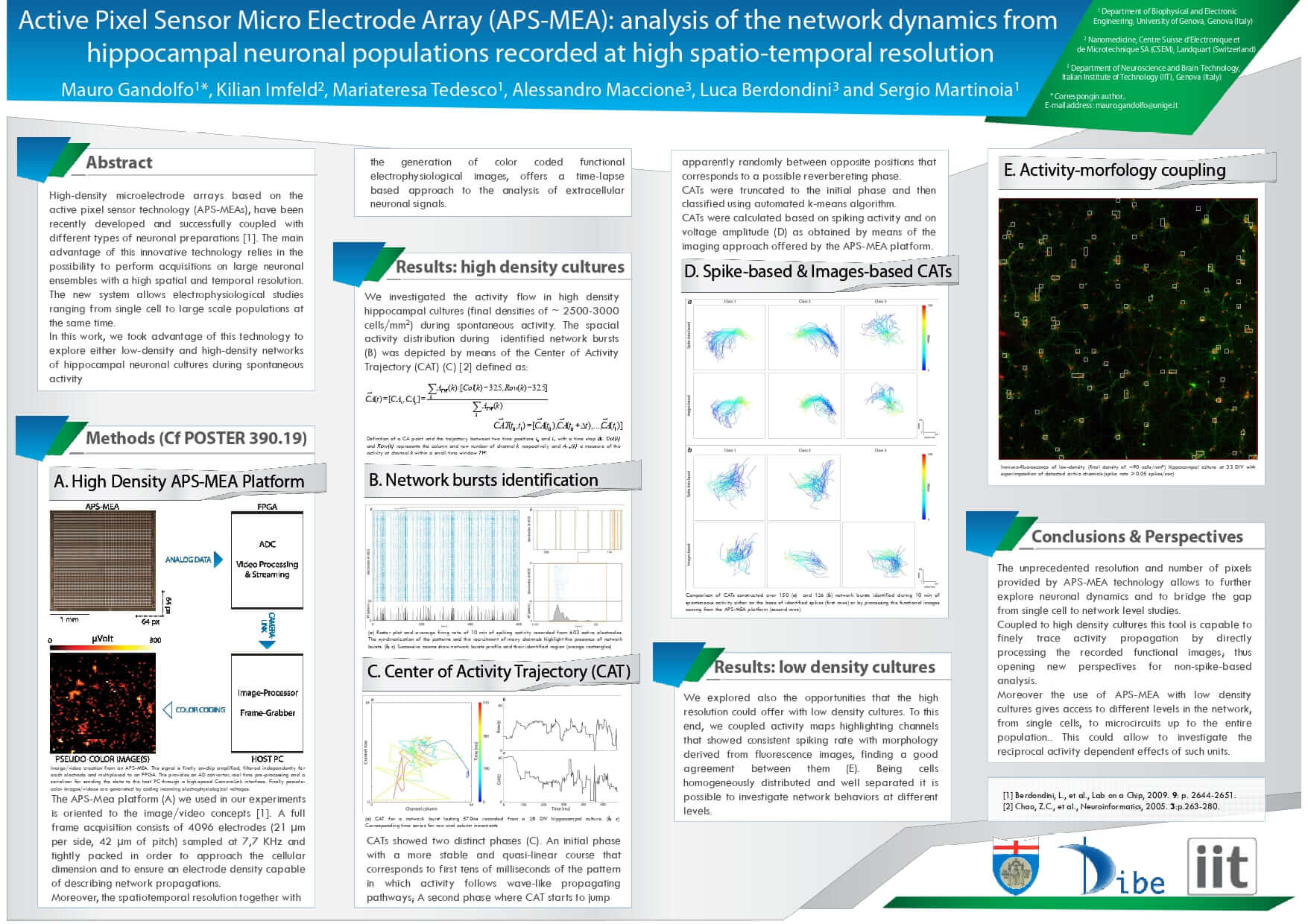
Active Pixel Sensor Micro Electrode Array (APS-MEA): analysis of the network dynamics from hippocampal neuronal populations recorded at high spatio-temporal resolution
SFN meeting (2009). Chicago, IL, USA.

2009
Keywords:
Technology
(conf. proc.)
Active Pixel Sensor Micro Electrode Arrays (APS-MEA): perspectives and challenges using a high resolution neuroelectronic interface for functional electrophysiological imaging of in-vitro neuronal net
SFN meeting (2009). Chicago, IL, USA.
2009
Keywords:


Neuronal Cultures
(paper)
Active pixel sensor array for high spatio-temporal resolution electrophysiological recordings from single cell to large scale neuronal networks
Lab on a Chip (2009). DOI: 10.1039/B907394A
2009
Keywords:
This paper presents a chip-based electrophysiological platform enabling the study of micro- and macro-circuitry in in-vitro neuronal preparations. The approach is based on a 64 × 64 microelectrode array device providing extracellular electrophysiological activity recordings with high spatial (21 µm of electrode separation) and temporal resolution (from 0.13 ms for 4096 microelectrodes down to 8 µs for 64 microelectrodes). Applied to in-vitro neuronal preparations, we show how this approach enables neuronal signals to be acquired for investigating neuronal activity from single cells and microcircuits to large scale neuronal networks. The main elements of the platform are the metallic microelectrode array (MEA) implemented in Complementary Metal Oxide Semiconductor (CMOS) technology similar to a light imager, the in-pixel integrated low-noise amplifiers (11 µVrms) and the high-speed random addressing logic. The chip is combined with a real-time acquisition system providing the capability to record at 7.8 kHz/electrode the whole array and to process the acquired signals.

Signal Processing
(paper)
A novel algorithm for precise identification of spikes in extracellularly recorded neuronal signals
J. Neurosci. Methods (2009). DOI: 10.1016/j.jneumeth.2008.09.026
2009
Keywords:
The spike represents the fundamental bit of information transmitted by the neurons within a network in order to communicate. Then, given the importance of the spike rate as well as the spike time for coding the activity generated at the level of a cell assembly, a relevant issue in extracellular electrophysiology is the correct identification of the spike in multisite recordings from brain areas or neuronal networks. In this paper, we present a novel spike detection algorithm, named Precise Timing Spike Detection (PTSD), aimed at (i) reducing the number of false positives and false negatives, in order to optimize the rate code, and (ii) improving the time precision of the identified spike, in order to optimize the spike timing. The PTSD algorithm considers consecutive portions of the signal and looks for the Relative Maximum/Minimum whose peak-to-peak amplitude is above a defined differential threshold and responds to specific requirements. To validate the algorithm, the presented spike detection has been compared with other methods either commercially available or proposed in the literature by using two benchmarking procedures: (i) visual inspection by a group of experts of a portion of signal recorded from a rat cortical culture and (ii) detection of the spikes generated by a realistic neuronal network model. In both cases our algorithm produced the best performances in terms of efficiency and precision. The ROC curve analysis further proved that the best results are reached by the application of the PTSD.

Signal Processing
(paper)
Real-time signal processing for high-density microelectrode array systems
Int. J. Adapt. Control (2009). DOI: 10.1002/acs.1077
2008
Keywords:
The microelectrode array (MEA) technology is continuously progressing towards higher integration of an increasing number of electrodes. The ensuing data streams that can be of several hundreds or thousands of Megabits/s require the implementation of new signal processing and data handling methodologies to substitute the currently used off-line analysis methods. Here, we present one approach based on the hardware implementation of a wavelet-based solution for real-time processing of extracellular neuronal signals acquired on high-density MEAs. We demonstrate that simple mathematical operations on the discrete wavelet transform (DWT) coefficients can be used for efficient neuronal spike detection and sorting. As the DWT is particularly well suited for implementation on dedicated hardware, we elaborated a wavelet processor on a field programmable gate array (FPGA) in order to compute the wavelet coefficients on 256 channels in real-time. By providing sufficient hardware resources, this solution can be easily scaled up for processing more electrode channels.

Cardiomyocyte
(paper)
Large-scale, high-resolution data acquisition system for extracellular recording of electrophysiological activity.
IEEE Trans. Biomed. Eng. (2008). DOI: 10.1109/TBME.2008.919139.
2008
Keywords:
A platform for high spatial and temporal resolution electrophysiological recordings of in vitro electrogenic cell cultures handling 4096 electrodes at a full frame rate of 8 kHz is presented and validated by means of cardiomyocyte cultures. Based on an active pixel sensor device implementing an array of metallic electrodes, the system provides acquisitions at spatial resolutions of 42 microm on an active area of 2.67 mm x 2.67 mm, and in the zooming mode, temporal resolutions down to 8 micros on 64 randomly selected electrodes. The low-noise performances of the integrated amplifier (11 microV (rms)) combined with a hardware implementation inspired by image/video processing concepts enable high-resolution acquisitions with real-time preprocessing capabilities adapted to the handling of the large amount of acquired data.

.svg)