





Organoids & Spheroids
(paper)
Human brain organoids record the passage of time over multiple years
Nature (2026). DOI: 10.1038/s41586-026-10877-x

2026
Keywords:
The human brain develops and matures over an exceptionally prolonged period of time that spans nearly two decades of life. Processes that govern species-specific aspects of human postnatal brain development are difficult to study in animal models1. While human brain organoids offer a promising in vitro model, they have thus far been shown to largely mimic early stages of brain development. Here we develop human brain organoids for 5 years in culture, optimizing growth conditions to extend excitatory neuron viability beyond previous limits. Using maturation-associated modules derived from endogenous human brain, we show that brain organoids transcriptionally age with cell type specificity over years in culture. Whole-genome methylation profiling reveals that the predicted epigenomic age of organoids correlates precisely with time spent in vitro, and parallels epigenomic ageing in vivo. Notably, we show that in chimeric organoids generated by mixing neural progenitors of different ages, old progenitors rapidly produce late neuronal fates, skipping the production of earlier neuronal progeny, therefore showing that progenitors that age in organoids retain a memory of the time spent in vitro. The data indicate that human brain organoids can continue to mature and record the passage of time over many years in culture.

Brain Slices
(paper)
Cholesterol restores corticostriatal synaptic connectivity in Huntington’s disease through BDNF/TrkB signalling, supporting a role for cholesterol pathways implicated by human genetic modifier studies
Pharmacol. Res. (2026). DOI: 10.1016/j.phrs.2026.108375
2026
Keywords:
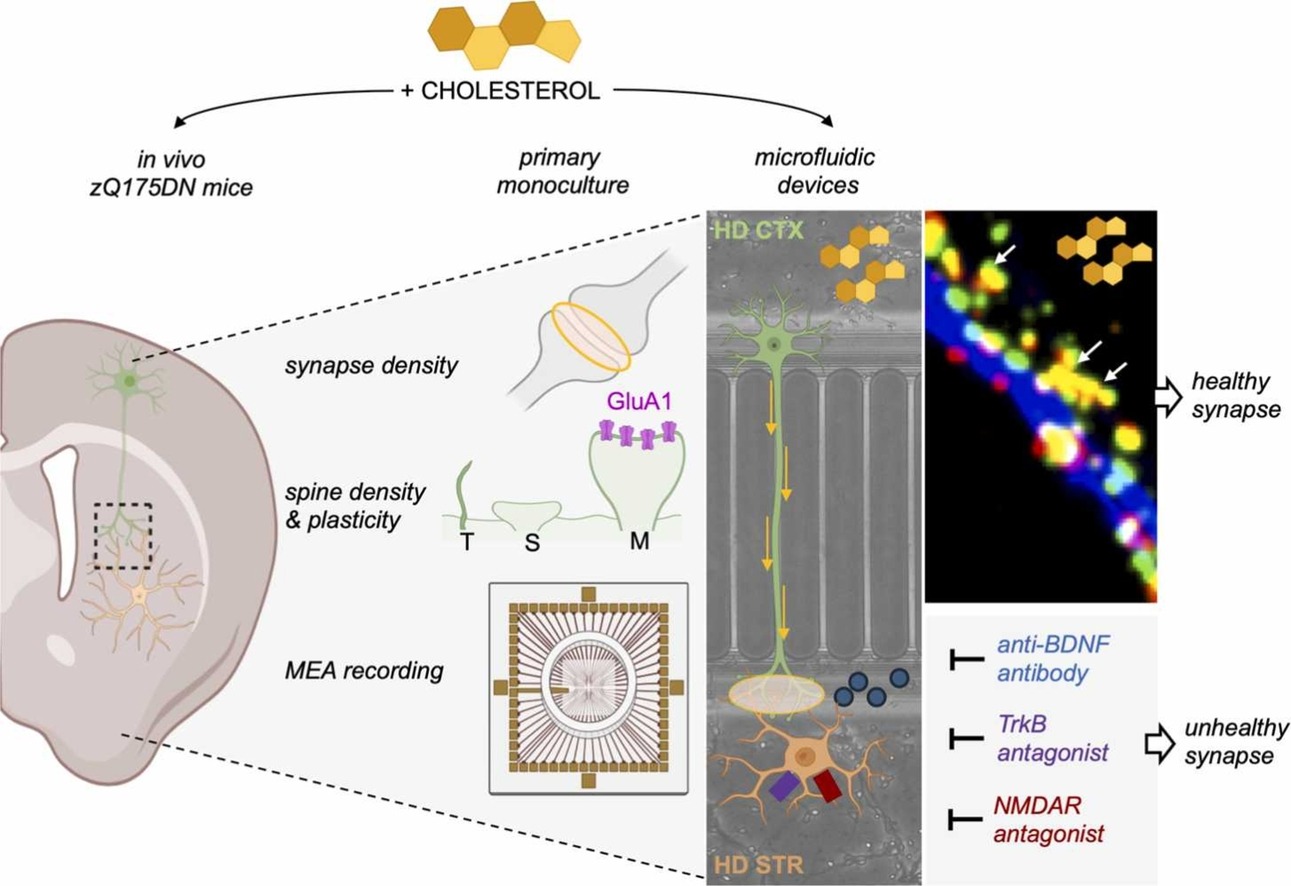
Corticostriatal synaptic dysfunction is an early hallmark of Huntington’s disease (HD), yet the mechanisms underlying synapse loss and its reversibility remain poorly understood. Brain cholesterol is essential for neuronal and synaptic function, and dysregulated cholesterol metabolism has emerged as a key feature of HD, with reduced cholesterol biosynthesis reported in rodent models and cholesterol replenishment shown to be beneficial. Consistent with these findings, GWAS identified HD modifier loci outside canonical DNA repair pathways, including MED15, which among its functions supports SREBP2-mediated transcription of cholesterol biosynthesis genes, and a chr22 locus encompassing SREBF2, the master regulator of cholesterol biosynthesis. These findings suggest that pathways regulating cholesterol homeostasis may contribute to modifying the course of HD.
Here, we show that increasing cholesterol availability prevents synapse loss and restores corticostriatal connectivity in HD models. Cholesterol supplementation restores excitatory synapse density in vivo and in vitro. In primary HD neurons, cholesterol stabilizes dendritic spines and promotes the enrichment of GluA1-containing AMPA receptors in mature mushroom spines during chemically induced long-term potentiation, consistent with improved synaptic plasticity. Using microfluidic devices to spatially resolve the corticostriatal circuitry, we identified a compartment-specific mechanism whereby cholesterol delivery to cortical neurons is necessary and sufficient to restore corticostriatal connectivity, whereas cholesterol administration to the striatal compartment selectively restores intrastriatal inhibitory synapses. Mechanistically, NMDA receptor and BDNF/TrkB signalling mediate the cholesterol-dependent restoration of synaptic connectivity, establishing cholesterol as a critical regulator of corticostriatal synaptic integrity in HD and supporting targeting cholesterol homeostasis as a therapeutic strategy to restore synaptic function.

Organoids & Spheroids
(paper)
Functional human-derived neurospheroids capture cortical-like network complexity
APL Bioeng. (2026). DOI: 10.1063/5.0335967
2026
Keywords:
Three-dimensional in vitro neuronal cultures have emerged as promising platforms for modeling human brain function and disease under controlled conditions. However, their ability to recapitulate in vivo-like complexity and rich dynamics remains unexplored. In this study, we developed and characterized neurospheroids derived from human-induced pluripotent stem cells to investigate how key features, such as three-dimensionality, cellular heterogeneity, and modular organization, contribute to replicating brain-like network dynamics. We engineered neurospheroids with varying excitatory/inhibitory ratios and assembled them into modular constructs (assembloids), evaluating their electrophysiological activity with high-density micro-electrode arrays capturing the basal layer of the 3D cultures. We assessed spontaneous and evoked activity through recent metrics of dynamical richness and perturbational complexity. Our results show that three-dimensionality significantly enhances the richness and complexity of network activity, reaching values that can be qualitatively contextualized with in vivo recordings, while cellular heterogeneity contributes to functional aspects of the network, such as nuanced activity patterns, dynamical variability, and modular coordination. Furthermore, the modular constructs demonstrate the scalability of this platform, opening the way to more complex network configurations. These findings highlight the critical role of spatial organization in reproducing cortical-like activity and lay the groundwork for future studies using patient-derived neurospheroids to model disease-specific dynamics.

Neuronal Cultures
(paper)
Reorganization of Burst Initiation Zones as a Signature of Stimulation-Induced Plasticity in in vitro Cortical Networks
eNeuro (2026). DOI: /10.1523/ENEURO.0457-25.2026
2026
Keywords:
The spontaneous activity of neuronal cultures is dominated by periods of coherent activity known as network bursts. The dynamics of the initiation and propagation of these bursts are believed to depend on the structural connectivity of the neuronal network. Specifically, the spatial loci of burst initiation, referred to as initiation zones (IZs), are shaped by a complex interplay between dynamics and connectivity, with the particular structure of the latter playing a crucial role. Thus, alterations in network structure, such as those following from plasticity mechanisms activated by perturbations, are expected to lead to changes in network burst dynamics. To shed light on this point, we investigated the effect of localized electrical stimulation on the initiation of network bursts in in vitro cortical networks from embryonic rats of either sex cultured on high density micro-electrode arrays (HD-MEAs), and observed that electrical stimulation significantly altered the spatial patterning of IZs. To explore the mechanisms underlying these alterations, we assessed changes in effective connectivity (EC) using transfer entropy. Although both IZs and EC exhibited similar remodeling following stimulation, EC alone could not fully account for the observed IZ shifts. Moreover, IZ remodeling was largely unpredictable and independent of the stimulation site, suggesting that the observed changes were due to large-scale remodeling of connectivity structure, likely involving local potentiation/depotentiation and homeostatic mechanisms. Our findings provide evidence that electrical stimulation can remodel burst initiation and effective connectivity, although achieving precise local control appears unattainable.

Acute Retina
(paper)
Nitric oxide refines retinal circuit architecture independently of retinal wave dynamics
Cell Death Discov. (2026). DOI: /10.1038/s41420-026-03228-2
2026
Keywords:
How diffusible neuromodulators control neural circuit assembly remains a key open question in neuroscience. While nitric oxide (NO) is known to regulate mature synaptic plasticity, its role during development, specifically whether it shapes circuits through activity-dependent or activity-independent pathways, has not been fully understood. Here, we combine ultrasensitive electron paramagnetic resonance (EPR) spectroscopy, 4096-channel high-density multielectrode array (HD-MEA) recordings, and advanced graph-theoretical analysis to study how NO contributes to retinal network formation during a critical period of synaptogenesis. In the rat retina, nNOS expression begins at postnatal day 10 in two distinct amacrine cell subtypes, coinciding with the first detectable NO production. Acute or selective nNOS inhibition preserved the spatiotemporal features of Stage III retinal waves but significantly changed network topology, increasing network degree and density. Molecular profiling showed that nNOS blockade lowered the expression of chemical (SYN, SYP) and electrical (Cx36, Cx45) synaptic genes, disrupted their laminar distribution in vivo, and increased neurite length in primary retinal cultures without altering branching complexity. By combining ultrasensitive NO detection, large-scale electrophysiology, and mathematical network analysis, our results identify NO as a key regulator of circuit refinement that operates largely independently of the spatiotemporal dynamics of retinal waves during development. These findings reveal a molecular mechanism by which diffusible modulators shape neural networks independently of patterned activity and offer a framework for understanding how altered NO signaling might contribute to neurodevelopmental disorders characterized by impaired synaptic organization.

Organoids & Spheroids
(paper)
Engineering functional ventral midbrain dopaminergic neurons in human organoids through WNT modulation and bioreactor culture
Mol. Psychiatry (2026). DOI: 10.1038/s41380-026-03667-4
2026
Keywords:
Human midbrain organoids (hMOs) derived from induced pluripotent stem cells provide a powerful system to model disorders involving dopamine (DA) dysfunction, including Parkinson’s disease (PD) and neuropsychiatric conditions. However, current differentiation protocols still fall short in recapitulating early specification, substantia nigra pars compacta (SNpc)-like identity, and the functional maturation of vulnerable DA neurons. Here, we established a differentiation strategy that combines tri-phasic WNT modulation with dynamic bioreactor culture to generate hMOs enriched in SNpc-like DA neurons. This approach significantly increases the yield of TH⁺/GIRK2⁺ and TH⁺/ALDH1A1⁺ DA neurons and promotes enhanced synaptic maturation, robust electrophysiological activity, and elevated DA release. Single-cell transcriptomics revealed that this strategy drives the emergence of SOX6+/GIRK2+ SNpc-like neurons, accompanied by upregulation of synaptic, metabolic, and maturation programs, alongside reduced cell stress and apoptotic signaling. Importantly, hMOs demonstrated vulnerability upon exposure to α-synuclein preformed fibrils, resulting in aggregate formation and DA neuron degeneration, supporting their use as a human model of PD-relevant pathology. Overall, this system provides a scalable and physiologically relevant approach to investigate molecular mechanisms underlying neurodegeneration and DA-related disorders.

Brain Slices
(paper)
Investigating The Network-Wide Mechanisms of Pallidal Deep Brain Stimulation Using High-Density Microelectrode Arrays
J. Vis. Exp. (2026). DOI: 10.3791/70507
2026
Keywords:
Dystonia is a neurological movement disorder characterized by abnormal muscle control affecting voluntary movements and sustained postures. Although dystonia is associated with basal ganglia dysfunction, increasing evidence suggests that the cerebellum is involved in its pathophysiology. This protocol presents in vivo pallidal deep brain stimulation (DBS) in a dystonic hamster model (dtsz hamster) combined with ex vivo high-density microelectrode array (HD-MEA) recordings to investigate cerebellar activity. The protocol includes (1) DBS surgery for electrode and stimulator implantation, (2) acute cerebellar slice preparation, (3) high-resolution electrophysiological recordings, and (4) data analysis. Representative results indicate that 11 days of pallidal DBS restored spike activity toward normal levels in the molecular, Purkinje, and granular layers, consistent with cerebellar network involvement in dystonia. This protocol enables detailed analysis of cerebellar activity and its modulation by DBS, providing a platform to investigate network-level mechanisms underlying neuromodulation therapies.

Acute Retina
(paper)
Developmental Synchrony of Retinal Waves, Apoptosis, and Angiogenesis in Postnatal Retina
eLife (2026). DOI: 10.7554/eLife.111419.1
2026
Keywords:
Postnatal mouse retinal development is a multi-faceted process involving the coordinated interaction of spontaneous neural activity as retinal waves, vascular plexus growth, and programmed cell death. While these processes are known to interact at a coarse scale, the specific mechanisms integrating them have remained elusive. Using large-scale, widefield calcium imaging, high-density multielectrode array recordings, single cell RNA-seq, and immunohistochemistry, we characterise a tightly aligned centrifugal expansion pattern during retinal development. This pattern is common to stage II retinal wave onsets, vascular development, Heme oxygenase-1 (Hmox1) expressing microglia, apoptotic cell markers, and a novel set of auto-fluorescent cluster complexes (ACCs) identified in this study. Apoptotic cells are known to upregulate functional Pannexin1 (PANX1) hemichannels. These voltage-gated channels release purinergic molecules which act as “eat me” signals to neighbouring microglia. PANX1 hemichannel blockade with the drug probenecid results in a profound decrease in spontaneous wave frequency and strength, suggesting that retinal waves are indeed triggered by these apoptotic cells.
Taken together, our observations suggest that spontaneous waves are initially triggered in hotspots by hyperactive apoptotic RGCs in unvascularised retinal areas. These apoptotic cells release purinergic molecules via PANX1 hemichannels, leading to wave generation. This hyperactivity leads to local hypoxic conditions, which, coupled with high extracellular ATP concentrations, promotes angiogenesis. Once blood vessels reach a particular hotspot, ATP release activates Hmox1 positive microglia, which engulf the dying RGCs, creating the auto-fluorescent clusters. We suggest that these early occurring events may be universal in the developing CNS, causally linking early neural activity, programmed cell death and angiogenesis.
Brain Slices
(paper)
Seize the Data: A User-Friendly GUI for High-Resolution Analysis of Seizure Dynamics in HD-MEA Recordings
eNeuro (2026). DOI: 10.64898/2026.01.07.698219
2026
Keywords:
High-density multielectrode arrays (HD-MEAs) generate large, complex datasets that are challenging to efficiently manage and analyze with existing tools, especially in open-source environments. To address this, we developed the BYU Seizure and Analytics Tool (YSA), an open-source graphical user interface built in Python and C++ for efficient analysis and visualization of HD-MEA recordings. The YSA features raster plots, automated discharge detection and tracking, downsampling, playback, and export functions, enabling streamlined workflows for large-scale neural data. We demonstrate the utility of the tool in the context of seizure and status epilepticus-like activity, highlighting how the YSA facilitates rapid exploration of the spatiotemporal dynamics in brain networks. This platform provides an accessible and practical solution for HD-MEA data analysis, supporting a range of neuroscience applications.

Organoids & Spheroids
(paper)
A layered approach to secure the safety and therapeutic efficacy of hiPSC-derived functionalized neuronal tissueoid for repair after complete spinal cord lnjury in rats
Chem. Eng. J. (2026). DOI: 10.1016/j.cej.2026.177575
2026
Keywords:
The functional integration of donor neurons with host neural pathways is a critical treatment for spinal cord injury (SCl). We constructed human induced pluripotent stem cell (hiPSC)-derived neuronal tissueoids (Ntoids) transfected with thymidine kinase (TK) to transplant donor neurons into SCl rats. Ntoids were produced after 28-days culture in a 3-dimensional gelatin sponge scaffold and possessed neuronal cells with synaptic transmission and neural network property in vitro. Ganciclovir, a TK substrate, depleted proliferative cells in Ntoids without affecting neuronal tissueoid formation, leaving non-mitotic and functionalized neuronal cells for transplantation. Ntoid-treated SCl rats achieved significantly better functional recovery in paralyzed hindlimbs and improved electrophysiological performance. Eight weeks after transplantation, remarkable surviving of donor cells suffused the entire injury/graft site and did not present discernible long-distance cell migration, leading to intensive innervation of the injury/graft site. Ntoids possessed cholinergic hiPSC-derived neurons that survived at the injury/graft site, partially integrating with regenerating nerve fibers and neurons via synapse-like contacts. Some donor cells differentiated into astrocytes and formed a chimeric blood/spinal cord barrier with the host's vascular epithelium. Ntoids represent a structural and functional neuronal relay to restore functionality in paralyzed limbs. An additional assembloid model also presented robust synapse formation between human brain organoid and Ntoid. These findings support the safety and efficacy of the transplantation of neuronal tissue with safety-regulatory mechanisms to treat SCI and provide a framework for future clinical application using tissue-engineered Ntoid.

Technology
(paper)
Measuring Electrophysiological Activity in Acute Brain Slices, Spheroids, and Organoids Using 3D High-Density Multielectrode Arrays
Bio-protoc. (2026). DOI: 10.21769/BioProtoc.5708
2026
Keywords:
Animal and human stem cell–derived three-dimensional models to study physio-pathological brain functioning are becoming a gold standard for in vitro electrophysiology, as they enable the recapitulation of complex network properties by accounting for spatial architectural features that better reflect in vivo conditions than simpler 2D models. Standard planar multielectrode arrays (MEAs), typically providing tens of recording electrodes, are commonly used to record activity from 2D neuronal cultures. However, when adapted for use with 3D models, planar 2D MEAs showed limited effectiveness. The main issues are limited specimen adhesion to the chip, a low number of sensing elements, inability to retrieve signals from within the tissue, and reduced perfusion and vitality of the tissue in contact with sensors. To overcome these limitations, a new generation of microchip-based 3D high-density MEAs (3D HD-MEA) has been developed and validated in recent years. This technological advancement has improved the sensing capabilities and the vitality of 3D models, providing a tool tailored to maximize their potential. Here, we present an optimized protocol for neural network activity recordings in 3D models (including acute slices, brain spheroids, and organoids) from various brain regions using 3D HD-MEAs. First, we summarize the critical steps for 1) obtaining viable acute slices from the mouse cerebellum, cortico-hippocampal circuit, and prefrontal cortex, 2) establishing efficient coupling of the slices with the chip, and 3) performing recordings and analyses. We then describe the main procedures required to obtain human and animal brain spheroids and neural organoids, as well as standardized routines to perform effective recordings and analyses. For each section, we highlight the crucial steps, identify tips for specific applications, and propose troubleshooting procedures. For example, the same type of preparation (e.g., acute slices) requires different adjustments when working with different brain areas. The specific information provided here is intended to assist researchers in their daily efforts to obtain efficient and reproducible functional recordings from 3D models by using the cutting-edge technique of 3D HD-MEA.

Acute Retina
(paper)
PTEN regulates starburst amacrine cell dendrite morphology during development
Development (2026). DOI: 10.1242/dev.204980
2026
Keywords:
Neurons are subject to extensive developmental regulation to ensure precise subtype-specific morphologies that are intimately tied to their function. Starburst amacrine cells (SACs) in the mammalian retina have a highly stereotyped, radially symmetric dendritic arbor that is essential for their role in direction-selective circuits in the retina. We show that PTEN, the primary negative regulator of the PI3K-AKT-mTOR pathway that is highly implicated in neurodevelopmental disorders, regulates SAC morphology in a cell-autonomous manner. Pten-deficient mouse SACs show a nearly twofold increase in the number of dendritic branches, while other morphological properties remain largely unchanged. These morphological changes arise late in SAC development, after dendrite development is largely complete, and persist into adulthood. Mechanistically, excessive dendritic branching appears to arise from dysregulated mTOR activity. Despite this increase in dendritic branches, Pten-deficient SACs maintain a normal population number, normal organization of synaptic outputs and intact direction-selectivity in the retina. Collectively, these results show that PTEN is essential in mouse for the normal development of highly stereotyped neuronal morphology.

Technology
(paper)
Bringing cellular clarity to the cortical component of ALSwith a high-density multi-electrode array system
FEBS J. (2026). DOI: 10.1111/febs.70552
2026
Keywords:
There is selective vulnerability in diseases, requiring the understanding ofcell-type specific aspects of neurodegeneration with cellular resolution.Single-cell electrophysiology enables direct investigation of neuronal excit-ability, ion-channel dynamics, and synaptic transmission with high tempo-ral precision, which is crucial in understanding neuronal circuitries andhow they are affected in diseases. Microelectrode arrays (MEAs) haveemerged as powerful platforms enabling long-term, parallel, andnon-invasive extracellular measurements. The advent of complementary-metal-oxide-semiconductor (CMOS)-based and high-density microelectrodearrays (HD-MEAs) has expanded the spatial and temporal resolutionattainable both in vitro and ex vivo. Combined with acute slices, novelcell-culture approaches and three-dimensional (3D) brain organoids, thesetools now expedite translational research in disease modeling, neurotoxic-ity, and pharmacology. Here, we summarise the significance of single-cellelectrophysiology, the advantages of the MEA systems, and the latest bio-medical and technological advances in this area of research.

Organoids & Spheroids
(paper)
Human microglia in brain assembloids display region-specific diversity and respond to hyperexcitable neurons carrying SCN2A mutation
Sci. Adv. (2026). DOI: 10.1126/sciadv.ady2977
2026
Keywords:
Microglia critically shape neuronal circuit development and function, yet their region-specific properties and roles in distinct circuits of the human brain remain poorly understood. In this study, we generated region-specific brain organoids (cortical, striatal, and midbrain), each integrated with human microglia, to fill this critical gap. Single-cell RNA sequencing uncovered six distinct microglial subtypes exhibiting unique regional signatures, including a subtype highly enriched for the GABAB receptor gene within striatal organoids. To investigate the contributions of microglia to neural circuitry, we created microglia-incorporated midbrain-striatal assembloids, modeling a core circuit node for many neuropsychiatric disorders, including autism. Using chemogenetics to activate this midbrain-striatal circuit, we observed increased calcium signaling in microglia involving GABAB receptors. Leveraging this model, we examined microglial responses within neural circuits harboring an SCN2A nonsense (C959X) mutation associated with profound autism. Microglia displayed heightened calcium responses to SCN2A mutation–mediated neuronal hyperactivity and engaged in excessive synaptic pruning. These pathological effects were reversed not only by pharmacological inhibition of microglial GABAB receptors but also by knockout of the GABBR1 gene in microglia. Collectively, our findings establish an advanced platform that can be used to dissect human neuroimmune interactions in subcortical regions and to evaluate previously undiscovered therapies, highlighting the important role of microglia in shaping critical circuitry related to neuropsychiatric disorders.

Organoids & Spheroids
(paper)
Human neuromuscular organoids mimic cancer-induced muscle cachexia
Cell Rep. Methods (2026). DOI: 10.1016/j.crmeth.2026.101331
2026
Keywords:
Motivation
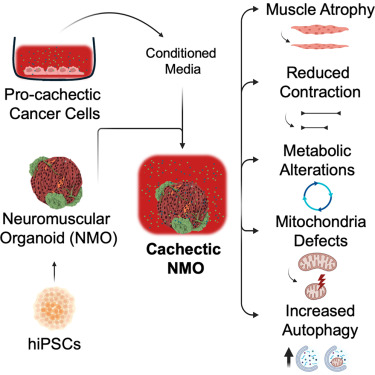
The study of mechanisms behind cancer-induced muscle cachexia is a significant challenge. Currently available in vivo and in vitro models are limited and do not allow the study of cachexia in a context that is relevant to patients. We therefore sought to develop a multicellular, three-dimensional (3D) in vitro model derived from human cells that recapitulates the phenotypes observed in a cachectic muscle, including impairment of muscle contraction and cellular and molecular alterations.
Highlights
· hiPSC-derived NMOs mature andrespond to genetically induced muscle atrophy
· NMOs mimic cachectic musclemorphology and function under pro-cachectic factors
· Cachectic NMOs show cancercachexia metabolic, mitochondrial, and molecular features
· NMOs offer a platform to studymechanisms and test potential cachexia therapies
Summary
Cancer cachexia, a devastating metabolic wasting syndrome affecting up to 80% of solid cancer patients, remains incurable despite advances in tumor biology understanding. This study introduces neuromuscular organoids (NMOs) derived from human-induced pluripotent stem cells (hiPSCs) as a platform to investigate cancer-driven muscle cachexia. We found that NMOs respond well to atrophic stimuli and replicate the key features of cancer cachexia when treated with conditioned media derived from cachexia-inducing cancer cells. Specifically, cachectic NMOs showed muscle mass loss, impairment of muscle contraction, alteration of intracellular calcium homeostasis, appearance of mitochondrial dysfunction with a metabolic shift, and enhancement of autophagy. Based on these results, we propose NMOs derived from hiPSCs as an in vitro tool for investigating human muscle cachexia, with potential future avenues of patient-specific modeling and therapeutic screening.
.png)
Neuronal Cultures
(paper)
Microscale dysfunction and mesoscale compensation in degenerating neuronal networks
Netw. Neurosci. (2026). DOI: 10.1162/NETN.a.552
2026
Keywords:
Progressive neurodegenerative diseases involve neuronal dysfunction across cellular, circuit, and whole-brain levels. Despite differences in anatomical origins, vulnerable neuronal subtypes, and specific misfolded proteins, these diseases share key features. In presymptomatic phases, neural networks engage compensatory processes to maintain function, including increased centralisation and reliance on a rich-club of hub nodes. While such mechanisms have supporting evidence in some disorders, they remain less established in ALS, limiting understanding of potential shared pre-symptomatic responses. To address this, we investigated structural and functional properties of ALS patient-derived motor neuron networks compared to healthy controls using longitudinal multielectrode array recordings and graph theory-based analysis. We observed microscale dysfunction marked by TDP-43 proteinopathy, hyperactivity, and reduced spike amplitude. Structurally, ALS networks exhibited neurite hypertrophy, suggesting attempts to form new connections. Mesoscale analyses revealed functional reconfigurations, including increased rich-club connectivity and network assortativity, indicating compensatory centralisation. Our findings provide novel evidence that ALS network features can be recapitulated in in vitro models, and that these networks progressively become more centralised to preserve computational capacity, imposing growing demands on hub nodes and predisposing them to further damage. These results support models proposing common network reconfiguration mechanisms across neurodegenerative diseases.
Organoids & Spheroids
(paper)
Multi-omic analysis of guided and unguided forebrain organoids reveals differences in cellular composition and metabolic profiles
Cell Rep. Methods (2026). DOI: 10.1016/j.crmeth.2025.101295
2026
Keywords:
Highlights
• We present a broad multi-omic analysis of guided and unguided forebrain organoids
• We demonstrate significant differences in neuronal and glial cell type compositions
• Guided and unguided forebrain organoids have different metabolic profiles
• Modeling of disease-relevant phenotypes may be influenced by choice of organoid method
Summary
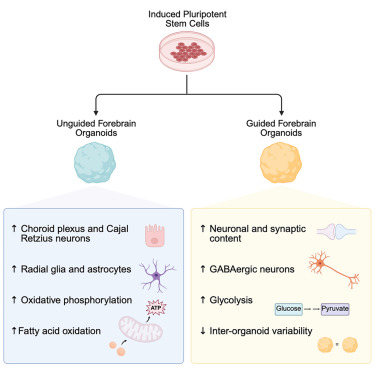
Neural organoids are invaluable model systems for studying neurodevelopment, generated by either guided or unguided approaches. Despite the importance for the field, the resulting differences between these models are unclear. To obtain an unbiased comparison, we performed a multi-omic analysis of forebrain organoids generated in parallel with two widely applied guided and unguided protocols. The guided forebrain organoids contained a larger proportion of neurons, including GABAergic interneurons, whereas the unguided organoids contained significantly more choroid plexus, radial glia, and astrocytes at later stages. Substantial differences in metabolic profiles were identified, pointing to increased levels of oxidative phosphorylation and fatty acid β-oxidation in the unguided forebrain organoids and a higher reliance on glycolysis in the guided forebrain organoids. Overall, our study comprises a thorough description of the multi-omic differences between these guided and unguided forebrain organoids and provides an important resource for the neural organoid field studying neurodevelopment and disease.

Neuronal Cultures
(paper)
Protocol for tailored in vitro neuronal networks on high-density microelectrode arrays with polydimethylsiloxane microstructures
STAR Protoc. (2026). DOI: 10.1016/j.xpro.2026.104349
2026
Keywords:

Complementary metal-oxide-semiconductor (CMOS)-based high-density microelectrode arrays (HD-MEAs) enable neuronal recordings with high spatiotemporal resolution. However, integrating polydimethylsiloxane (PDMS) microstructures onto HD-MEA surfaces to control network architecture is currently challenging and platform specific. Here, we present a protocol for PDMS fabrication, HD-MEA chip preparation, PDMS-HD-MEA microstructure alignment, and cell culture, including alternatives. Our results show reproducible formation of modular networks with characteristic activity patterns across different systems. This protocol supports engineering of defined neuronal architectures while maintaining compatibility with various HD-MEA systems.

Organoids & Spheroids
(paper)
Intermittent Propofol Exposure Induces Neurodevelopmental Alterations in Human Brain Organoids
Cell. Mol. Neurobiol. (2026). DOI: 10.1007/s10571-026-01673-2
2026
Keywords:
The administration of anaesthesia during pregnancy may have implications for fetal brain development. This study used H1 embryonic stem cell-derived human brain organoids (HBOs) to investigate effects of intermittent propofol exposure (IPE). HBOs were subjected to early IPE from 47 to 50 days in vitro (div), or late IPE from 77 to 80 div, using a clinically supra-anaesthetic concentration of 50 µM propofol. This was followed by cultivation without propofol for an additional 10 div, and HBOs were subsequently analysed at 60 or 90 div. Determination of HBO growth and lactate release did not provide evidence of neurotoxicity. Multi-electrode array recordings indicated an increased neuronal activity at 60 div following early IPE, an effect not observed at 90 div following late IPE. RNA-sequencing revealed that IPE up-regulated genes associated with neurodevelopment and synapse functions at 60 div, which overlapped with naturally up-regulated genes during HBO development from 60 to 90 div. These findings indicate that early IPE accelerates brain maturation in HBOs, suggesting possible deviations from the normal developmental trajectory in the fetal brain.

Brain Slices
(paper)
Organotypic human brain slice cultures as a translational testing platform for novel neuromodulation devices
J. Neural Eng. (2026). DOI: 10.1088/1741-2552/ae34e9
2026
Keywords:
To establish organotypic human brain slice cultures (hBSCs) as a translational screening platform for evaluating novel neuromodulation devices and to demonstrate the feasibility of the model using magnetoelectric nanoparticles (MENPs) as a representative neurostimulation modality.
Approach: Viable hBSCs were prepared from resected cortical tissue of epilepsy surgery patients and a GCaMP-based calcium imaging, multi-electrode array (MEA) recordings, and immunohistochemical staining for c-Fos was conducted. The MENPs were injected into the hBSCs and stimulated with an alternating magnetic field to assess their neuromodulatory effects.
Main Results: GCaMP transduction enables the real-time visualization of MENP-induced neuronal activity. Electrophysiological signals, including spiking and local field potentials, were observed in fresh, but not cultured, slices. c-Fos immunostaining revealed a significant increase in c-Fos expression in stimulated MENP-injected cultures compared to sham-treated controls. This protocol yielded reproducible tissue viability and consistent results across patient-derived samples.
Significance: This technical note demonstrates that hBSCs represent a reproducible and ethically preferable translational model suitable for screening applications in neurotechnology research. The platform enables early-stage functional evaluation of neuromodulatory devices, particularly those with a higher risk of failure in vivo or curiosity-driven early-phase concepts in a setting superior to traditional in vitro approaches. This platform may help reduce reliance on animal models in neurotechnology development.

Organoids & Spheroids
(paper)
Targeted antisense oligonucleotide treatment rescues developmental alterations in spinal muscular atrophy organoids
Nat. Commun. (2025). DOI: 10.1038/s41467-025-67725-1
2025
Keywords:
Spinal muscular atrophy (SMA) is a severe neurological disease caused by mutations in the SMN1 gene, characterized by early onset and degeneration of lower motor neurons. Understanding early neurodevelopmental defects in SMA is crucial for optimizing therapeutic interventions. Using spinal cord and cerebral organoids generated from multiple SMA type 1 male donors, we revealed widespread disease mechanisms beyond motor neuron degeneration. Single-cell transcriptomics uncovered pervasive alterations across neural populations, from progenitors to neurons, demonstrating SMN-dependent dysregulation of neuronal differentiation programs. Multi-electrode array (MEA) analysis identified consistent hyperexcitability in both spinal and brain organoids, establishing altered electrical properties as a central nervous system-wide feature of pathogenesis. Early administration of an optimized antisense oligonucleotide (ASO) that increased SMN levels rescued morphological and functional deficits in spinal cord organoids across different genetic backgrounds. Importantly, this early intervention precisely corrected aberrant splicing in here identified SMN1 targets enriched at critical nodes of neuronal differentiation. Our findings demonstrate that early developmental defects are core features of SMA pathogenesis that can be prevented by timely therapeutic intervention, providing insights for optimizing treatment strategies.

Brain Slices
(conf. proc.)
Network-Level Characterization of Hippocampal Disruptions in Alzheimer’s Disease Using Large-Scale Electrophysiology
IEEE EMBC (2025). DOI: 10.1109/EMBC58623.2025.11253272.
2025
Keywords:
Alzheimer’s disease (AD), a progressive neurodegenerative disorder, is projected to affect over 130 million people globally by 2050. While extensive efforts have focused on targeting molecular hallmarks such as amyloid-beta (Aβ) plaques and tau pathology, network-level dysfunction remains a critical but underexplored component of AD progression. Disruptions in hippocampal-cortical (HC) circuit activity emerge early in AD, compromising memory processing and cognitive functions. Characterizing these disruptions requires high-resolution platforms capable of capturing network-wide spatiotemporal dynamics. To address this, we implemented a high-density microelectrode array (HD-MEA) biosensor to assess large-scale electrophysiological activity in ex vivo hippocampal slices from well-established APPNL and APPNL-G-F mouse models. Our approach quantifies hippocampal oscillatory disturbances and examines their modulation by saffron, a natural compound with reported neuroprotective properties. Results indicate that hippocampal network activity is progressively impaired in APPNL-G-F mice, particularly in sharp-wave ripple (SWR) and multi-unit activity (MUA) patterns. The HD-MEA platform provides a scalable tool for investigating AD-associated network dysfunctions and exploring potential modulatory interventions.
Neuronal Cultures
(paper)
Protocol for the enhanced analysis of electrophysiological data from high-density multi-electrode arrays with nicespike and spikeNburst
STAR Protoc. (2025). DOI: /10.1016/j.xpro.2025.104195
2025
Keywords:

High-density multi-electrode arrays enable the recording of in vitro neuronal activity with exceptional spatial and temporal resolution. Here, we describe a protocol for analyzing these extensive datasets by using two complementary tools. The nicespike tool implements a full electrophysiological data analysis pipeline featuring graphics processing unit–accelerated spike sorting via template matching with Kilosort, enabling accurate identification of neuronal units across multiple electrodes. The spikeNburst tool incorporates advanced techniques for spike train filtering, burst and network burst detection, and synchronization analysis.

Brain Slices
(paper)
High-density multielectrode array (MEA) recordings in a rodent glioma model
J. Neurosci. Methods (2025). DO: /10.1016/j.jneumeth.2025.110623
2025
Keywords:
• Network bursts were induced in acute brain slices from glioma-bearing rats.
• 64 × 64 multielectrode arrays allowed for detailed recording of network bursts.
• Center-of-activity trajectories and activity propagation analysis were described.
• Network bursts differed between glioma-bearing slices and controls.
• Spike Time Tiling Coefficient-based functional connectivity graphs were constructed.

Organoids & Spheroids
(paper)
Generation of human nucleus basalis organoids with functional nbM-cortical cholinergic projections in transplanted assembloids
Cell Stem Cell (2025). DOI: 10.1016/j.stem.2025.10.004
2025
Keywords:
Highlights
• Human nbM organoids generated from hPSCs recapitulate nucleus-specific identity
• hnbMOs establish long projection and functional connectivity with hCOs in vitro
• Assembloid transplantation formed the functional nbM-cortical cholinergic pathway
• nbM-cortical assembloids model projection deficits in Down syndrome
Summary
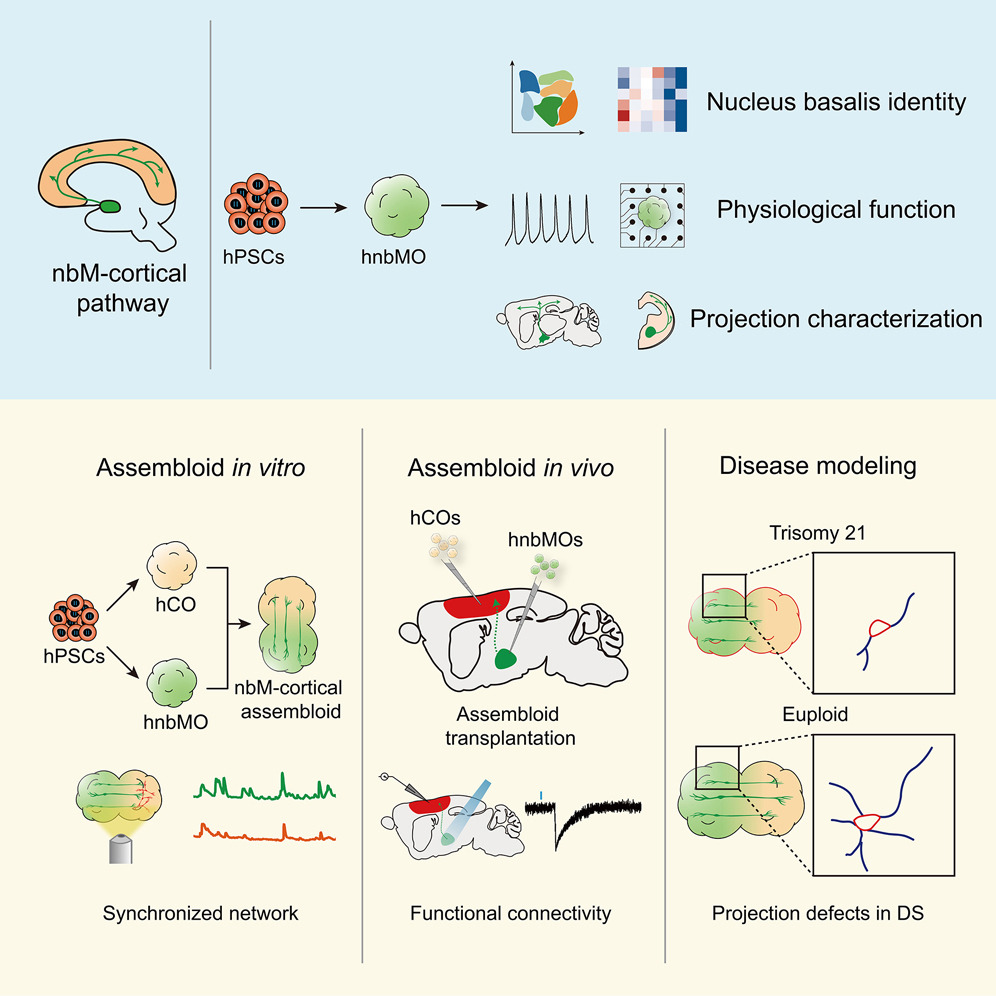
The nucleus basalis of Meynert (nbM), the major cholinergic output of the basal forebrain, regulates cortical modulation, learning, and memory. Dysfunction of the nbM-cortical cholinergic pathway is implicated in neurodegenerative and neurodevelopmental disorders, including Alzheimer’s disease (AD) and Down syndrome (DS). Here, we generated human nbM organoids (hnbMOs) from human pluripotent stem cells (hPSCs) containing functional cholinergic projection neurons. Then we reconstructed long-distance cholinergic projections from nbM to the cortex by co-culturing hnbMOs with human fetal brains and transplanting hnbMOs into immunodeficient mice. We further established nbM-cortical assembloids by fusing hnbMOs with human cortical organoids (hCOs). We also established a human-specific cholinergic projection system in transplanted assembloids. Using viral tracing and functional assays, we validated that cholinergic neurons send projections into hCOs and form synaptic connections. Moreover, we captured projection deficits in DS-derived assembloids, demonstrating the utility of this model for studying nbM-related neural circuits and neurological disorders.

.svg)