





Technology
(paper)
Exploiting All Programmable SoCs in Neural Signal Analysis: A Closed-Loop Control for Large-Scale CMOS Multielectrode Arrays
IEEE Trans. Biomed. Circuits Syst. (2018). DOI: 10.1109/TBCAS.2018.2830659

2018
Keywords:
Microelectrode array (MEA) systems with up to several thousands of recording electrodes and electrical or optical stimulation capabilities are commercially available or described in the literature. By exploiting their submillisecond and micrometric temporal and spatial resolutions to record bioelectrical signals, such emerging MEA systems are increasingly used in neuroscience to study the complex dynamics of neuronal networks and brain circuits. However, they typically lack the capability of implementing real-time feedback between the detection of neuronal spiking events and stimulation, thus restricting large-scale neural interfacing to open-loop conditions. In order to exploit the potential of such large-scale recording systems and stimulation, we designed and validated a fully reconfigurable FPGA-based processing system for closed-loop multichannel control. By adopting a Xilinx Zynq-all-programmable system on chip that integrates reconfigurable logic and a dual-core ARM-based processor on the same device, the proposed platform permits low-latency preprocessing (filtering and detection) of spikes acquired simultaneously from several thousands of electrode sites. To demonstrate the proposed platform, we tested its performances through ex vivo experiments on the mice retina using a state-of-the-art planar high-density MEA that samples 4096 electrodes at 18 kHz and record light-evoked spikes from several thousands of retinal ganglion cells simultaneously. Results demonstrate that the platform is able to provide a total latency from whole-array data acquisition to stimulus generation below 2 ms. This opens the opportunity to design closed-loop experiments on neural systems and biomedical applications using emerging generations of planar or implantable large-scale MEA systems.

Organoids & Spheroids
(paper)
Human‐Induced Pluripotent Stem Cells Generate Light Responsive Retinal Organoids with Variable and Nutrient‐Dependent Efficiency
Stem Cells (2018). DOI: 10.1002/stem.2883
2018
Keywords:
The availability of in vitro models of the human retina in which to perform pharmacological and toxicological studies is an urgent and unmet need. An essential step for developing in vitro models of human retina is the ability to generate laminated, physiologically functional, and light-responsive retinal organoids from renewable and patient specific sources. We investigated five different human-induced pluripotent stem cell (iPSC) lines and showed a significant variability in their efficiency to generate retinal organoids. Despite this variability, by month 5 of differentiation, all iPSC-derived retinal organoids were able to generate light responses, albeit immature, comparable to the earliest light responses recorded from the neonatal mouse retina, close to the period of eye opening. All iPSC-derived retinal organoids exhibited at this time a well-formed outer nuclear like layer containing photoreceptors with inner segments, connecting cilium, and outer like segments. The differentiation process was highly dependent on seeding cell density and nutrient availability determined by factorial experimental design. We adopted the differentiation protocol to a multiwell plate format, which enhanced generation of retinal organoids with retinal-pigmented epithelium (RPE) and improved ganglion cell development and the response to physiological stimuli. We tested the response of iPSC-derived retinal organoids to Moxifloxacin and showed that similarly to in vivo adult mouse retina, the primary affected cell types were photoreceptors. Together our data indicate that light responsive retinal organoids derived from carefully selected and differentiation efficient iPSC lines can be generated at the scale needed for pharmacology and drug screening purposes.

Signal Processing
(conf. proc.)
Spike Train Synchrony Analysis of Neuronal Cultures
International Joint Conference on Neural Networks (IJCNN) (2018). DOI: 10.1109/IJCNN.2018.8489728
2018
Keywords:
Spike train synchrony estimation of neuronal cultures provides valuable insights into firing patterns of neurons in terms of degree of similarity or dissimilarity. These estimations have proven to be a useful tool in neuroscience since synchrony in neuronal networks is thought to be related to cognitive processes, sensory awareness, learning and neurological disorders. Many mathematical measures have been developed to quantify the degree of synchrony. These synchrony metrics are generally used for smaller sets of spike trains and not been explored for larger High Density Multi Electrode Arrays (HD-MEA) datasets with thousands of channels. Here, bivariate and multivariate ISI-distance and SPIKE-distance metrics are utilized on both synthetic and experimental HD-MEA datasets to quantify spike train synchrony. It is demonstrated that, despite the significant size of the datasets, the approaches are effective in identifying and quantifying interesting bursting or change in spike train behaviours which are not always obvious from the raster plot.

Brain Slices
(conf. proc.)
Purkinje cells firing recorded by a high density multi-electrode array: a new tool for compounds validation
FENS conference (2018). Berlin, Germany.
2018
Keywords:


Brain Slices
(paper)
Constitutive Inactivation of the PRRT2 Gene Alters Short-Term Synaptic Plasticity and Promotes Network Hyperexcitability in Hippocampal Neurons
Cereb Cortex. (2018). DOI: 10.1093/cercor/bhy079
2018
Keywords:
Mutations in PRoline-Rich Transmembrane protein 2 (PRRT2) underlie a group of paroxysmal disorders including epilepsy, kinesigenic dyskinesia and migraine. Most of the mutations lead to impaired PRRT2 expression and/or function, emphasizing the pathogenic role of the PRRT2 deficiency. In this work, we investigated the phenotype of primary hippocampal neurons obtained from mouse embryos in which the PRRT2 gene was constitutively inactivated. Although PRRT2 is expressed by both excitatory and inhibitory neurons, its deletion decreases the number of excitatory synapses without significantly affecting the number of inhibitory synapses or the nerve terminal ultrastructure. Analysis of synaptic function in primary PRRT2 knockout excitatory neurons by live imaging and electrophysiology showed slowdown of the kinetics of exocytosis, weakened spontaneous and evoked synaptic transmission and markedly increased facilitation. Inhibitory neurons showed strengthening of basal synaptic transmission, accompanied by faster depression. At the network level these complex synaptic effects resulted in a state of heightened spontaneous and evoked activity that was associated with increased excitability of excitatory neurons in both PRRT2 knockout primary cultures and acute hippocampal slices. The data indicate the existence of network instability/hyperexcitability as the possible basis of the paroxysmal phenotypes associated with PRRT2 mutations.

Neuronal Cultures
(paper)
State-dependent representation of stimulus-evoked activity in high-density recordings of neural cultures
Sci. Rep. (2018). DOI: 10.1038/s41598-018-23853-x
2018
Keywords:
Neuronal responses to external stimuli vary from trial to trial partly because they depend on continuous spontaneous variations of the state of neural circuits, reflected in variations of ongoing activity prior to stimulus presentation. Understanding how post-stimulus responses relate to the pre-stimulus spontaneous activity is thus important to understand how state dependence affects information processing and neural coding, and how state variations can be discounted to better decode single-trial neural responses. Here we exploited high-resolution CMOS electrode arrays to record simultaneously from thousands of electrodes in in-vitro cultures stimulated at specific sites. We used information-theoretic analyses to study how ongoing activity affects the information that neuronal responses carry about the location of the stimuli. We found that responses exhibited state dependence on the time between the last spontaneous burst and the stimulus presentation and that the dependence could be described with a linear model. Importantly, we found that a small number of selected neurons carry most of the stimulus information and contribute to the state-dependent information gain. This suggests that a major value of large-scale recording is that it individuates the small subset of neurons that carry most information and that benefit the most from knowledge of its state dependence.

Acute Retina
(paper)
Eliminating Glutamatergic Input onto Horizontal Cells Changes the Dynamic Range and Receptive Field Organization of Mouse Retinal Ganglion Cells
J. Neurosci. (2018). DOI: https://doi.org/10.1523/JNEUROSCI.0141-17.2018
2018
Keywords:
In the mammalian retina, horizontal cells receive glutamatergic inputs from many rod and cone photoreceptors and return feedback signals to them, thereby changing photoreceptor glutamate release in a light-dependent manner. Horizontal cells also provide feedforward signals to bipolar cells. It is unclear, however, how horizontal cell signals also affect the temporal, spatial, and contrast tuning in retinal output neurons, the ganglion cells. To study this, we generated a genetically modified mouse line in which we eliminated the light dependency of feedback by deleting glutamate receptors from mouse horizontal cells. This genetic modification allowed us to investigate the impact of horizontal cells on ganglion cell signaling independent of the actual mode of feedback in the outer retina and without pharmacological manipulation of signal transmission. In control and genetically modified mice (both sexes), we recorded the light responses of transient OFF-α retinal ganglion cells in the intact retina. Excitatory postsynaptic currents (EPSCs) were reduced and the cells were tuned to lower temporal frequencies and higher contrasts, presumably because photoreceptor output was attenuated. Moreover, receptive fields of recorded cells showed a significantly altered surround structure. Our data thus suggest that horizontal cells are responsible for adjusting the dynamic range of retinal ganglion cells and, together with amacrine cells, contribute to the center/surround organization of ganglion cell receptive fields in the mouse.

Technology
(book chapter)
Fabrication of Multielectrode Arrays for Neurobiology Applications
Cell-Based Microarrays, Methods Mol. Biol. (2018). DOI: 10.1007/978-1-4939-7792-5_12
2018
Keywords:
Substrate-integrated multielectrode arrays (MEAs) enable multisite, long-term, and label-free sensing and actuation of neuronal electrical signals in reduced cell culture models for network electrophysiology. Conventional, thin-film fabricated passive MEAs typically provide a few tens of electrode sites. New generations of active CMOS-based high-resolution arrays provide the capabilities of simultaneous recordings from thousands of neurons over fields of view of several square millimeters, yet allowing extracellular electrical imaging to be achieved down to the subcellular scale. In turn, such advancement in chip-based electrical readouts can significantly complement recently developed biotechnological and bimolecular techniques for neurobiology applications. Here, we describe (1) a simple method to fabricate passive MEAs and (2) protocols for preparing and growing primary rat hippocampal neuronal cultures and human iPS-derived neurons on MEAs. The aim is to provide reliable protocols for initiating the reader to this technology and for stimulating their further development and experimental use in neurobiology.
Neuronal Cultures
(paper)
Developmental excitatory-to-inhibitory GABA-polarity switch is disrupted in 22q11.2 deletion syndrome: a potential target for clinical therapeutics
Sci. Rep. (2017). DOI: 10.1038/s41598-017-15793-9
2017
Keywords:
Individuals with 22q11.2 microdeletion syndrome (22q11.2 DS) show cognitive and behavioral dysfunctions, developmental delays in childhood and risk of developing schizophrenia and autism. Despite extensive previous studies in adult animal models, a possible embryonic root of this syndrome has not been determined. Here, in neurons from a 22q11.2 DS mouse model (Lgdel+/−), we found embryonic-premature alterations in the neuronal chloride cotransporters indicated by dysregulated NKCC1 and KCC2 protein expression levels. We demonstrate with large-scale spiking activity recordings a concurrent deregulation of the spontaneous network activity and homeostatic network plasticity. Additionally, Lgdel+/− networks at early development show abnormal neuritogenesis and void of synchronized spontaneous activity. Furthermore, parallel experiments on Dgcr8+/− mouse cultures reveal a significant, yet not exclusive contribution of the dgcr8 gene to our phenotypes of Lgdel+/− networks. Finally, we show that application of bumetanide, an inhibitor of NKCC1, significantly decreases the hyper-excitable action of GABAA receptor signaling and restores network homeostatic plasticity in Lgdel+/− networks. Overall, by exploiting an on-a-chip 22q11.2 DS model, our results suggest a delayed GABA-switch in Lgdel+/− neurons, which may contribute to a delayed embryonic development. Prospectively, acting on the GABA-polarity switch offers a potential target for 22q11.2 DS therapeutic intervention.

Signal Processing
(paper)
SPICODYN: A Toolbox for the Analysis of Neuronal Network Dynamics and Connectivity from Multi-Site Spike Signal Recordings
Neuroinform (2017). DOI: https://doi.org/10.1007/s12021-017-9343-z
2017
Keywords:
We implemented an automated and efficient open-source software for the analysis of multi-site neuronal spike signals. The software package, named SpiCoDyn, has been developed as a standalone windows GUI application, using C# programming language with Microsoft Visual Studio based on .NET framework 4.5 development environment. Accepted input data formats are HDF5, level 5 MAT and text files, containing recorded or generated time series spike signals data. SpiCoDyn processes such electrophysiological signals focusing on: spiking and bursting dynamics and functional-effective connectivity analysis. In particular, for inferring network connectivity, a new implementation of the transfer entropy method is presented dealing with multiple time delays (temporal extension) and with multiple binary patterns (high order extension). SpiCoDyn is specifically tailored to process data coming from different Multi-Electrode Arrays setups, guarantying, in those specific cases, automated processing. The optimized implementation of the Delayed Transfer Entropy and the High-Order Transfer Entropy algorithms, allows performing accurate and rapid analysis on multiple spike trains from thousands of electrodes.

Technology
(paper)
Recurrently connected and localized neuronal communities initiate coordinated spontaneous activity in neuronal networks
PLoS Comput. Biol. (2017). DOI: 10.1371/journal.pcbi.1005672
2017
Keywords:
Developing neuronal systems intrinsically generate coordinated spontaneous activity that propagates by involving a large number of synchronously firing neurons. In vivo, waves of spikes transiently characterize the activity of developing brain circuits and are fundamental for activity-dependent circuit formation. In vitro, coordinated spontaneous spiking activity, or network bursts (NBs), interleaved within periods of asynchronous spikes emerge during the development of 2D and 3D neuronal cultures. Several studies have investigated this type of activity and its dynamics, but how a neuronal system generates these coordinated events remains unclear. Here, we investigate at a cellular level the generation of network bursts in spontaneously active neuronal cultures by exploiting high-resolution multielectrode array recordings and computational network modelling. Our analysis reveals that NBs are generated in specialized regions of the network (functional neuronal communities) that feature neuronal links with high cross-correlation peak values, sub-millisecond lags and that share very similar structural connectivity motifs providing recurrent interactions. We show that the particular properties of these local structures enable locally amplifying spontaneous asynchronous spikes and that this mechanism can lead to the initiation of NBs. Through the analysis of simulated and experimental data, we also show that AMPA currents drive the coordinated activity, while NMDA and GABA currents are only involved in shaping the dynamics of NBs. Overall, our results suggest that the presence of functional neuronal communities with recurrent local connections allows a neuronal system to generate spontaneous coordinated spiking activity events. As suggested by the rules used for implementing our computational model, such functional communities might naturally emerge during network development by following simple constraints on distance-based connectivity.

Neuronal Cultures
(paper)
Selective Targeting of Neurons with Inorganic Nanoparticles: Revealing the Crucial Role of Nanoparticle Surface Charge
ACS Nano (2017). DOI: 10.1021/acsnano.7b00397
2017
Keywords:
Nanoparticles (NPs) are increasingly used in biomedical applications, but the factors that influence their interactions with living cells need to be elucidated. Here, we reveal the role of NP surface charge in determining their neuronal interactions and electrical responses. We discovered that negatively charged NPs administered at low concentration (10 nM) interact with the neuronal membrane and at the synaptic cleft, whereas positively and neutrally charged NPs never localize on neurons. This effect is shape and material independent. The presence of negatively charged NPs on neuronal cell membranes influences the excitability of neurons by causing an increase in the amplitude and frequency of spontaneous postsynaptic currents at the single cell level and an increase of both the spiking activity and synchronous firing at neural network level. The negatively charged NPs exclusively bind to excitable neuronal cells, and never to nonexcitable glial cells. This specific interaction was also confirmed by manipulating the electrophysiological activity of neuronal cells. Indeed, the interaction of negatively charged NPs with neurons is either promoted or hindered by pharmacological suppression or enhancement of the neuronal activity with tetrodotoxin or bicuculline, respectively. We further support our main experimental conclusions by using numerical simulations. This study demonstrates that negatively charged NPs modulate the excitability of neurons, revealing the potential use of NPs for controlling neuron activity.
Neuronal Cultures
(paper)
High-resolution bioelectrical imaging of Aβ-induced network dysfunction on CMOS-MEAs for neurotoxicity and rescue studies
Sci. Rep. (2017). DOI: 10.1038/s41598-017-02635-x
2017
Keywords:
Neurotoxicity and the accumulation of extracellular amyloid-beta1–42 (Aβ) peptides are associated with the development of Alzheimer’s disease (AD) and correlate with neuronal activity and network dysfunctions, ultimately leading to cellular death. However, research on neurodegenerative diseases is hampered by the paucity of reliable readouts and experimental models to study such functional decline from an early onset and to test rescue strategies within networks at cellular resolution. To overcome this important obstacle, we demonstrate a simple yet powerful in vitro AD model based on a rat hippocampal cell culture system that exploits large-scale neuronal recordings from 4096-electrodes on CMOS-chips for electrophysiological quantifications. This model allows us to monitor network activity changes at the cellular level and to uniquely uncover the early activity-dependent deterioration induced by Aβ-neurotoxicity. We also demonstrate the potential of this in vitro model to test a plausible hypothesis underlying the Aβ-neurotoxicity and to assay potential therapeutic approaches. Specifically, by quantifying N-methyl D-aspartate (NMDA) concentration-dependent effects in comparison with low-concentration allogenic-Aβ, we confirm the role of extrasynaptic-NMDA receptors activation that may contribute to Aβ-neurotoxicity. Finally, we assess the potential rescue of neural stem cells (NSCs) and of two pharmacotherapies, memantine and saffron, for reversing Aβ-neurotoxicity and rescuing network-wide firing.

Brain Slices
(paper)
Polyethylene glycol restores axonal conduction after corpus callosum transection
Neural Regen. Res. (2017). DOI: 10.4103/1673-5374.206645
2017
Keywords:
Polyethylene glycol (PEG) has been shown to restore axonal continuity after peripheral nerve transection in animal models. We hypothesized that PEG can also restore axonal continuity in the central nervous system. In this current experiment, coronal sectioning of the brains of Sprague-Dawley rats was performed after animal sacrifice. 3Brain high-resolution microelectrode arrays (MEA) were used to measure mean firing rate (MFR) and peak amplitude across the corpus callosum of the ex-vivo brain slices. The corpus callosum was subsequently transected and repeated measurements were performed. The cut ends of the corpus callosum were still apposite at this time. A PEG solution was applied to the injury site and repeated measurements were performed. MEA measurements showed that PEG was capable of restoring electrophysiology signaling after transection of central nerves. Before injury, the average MFRs at the ipsilateral, midline, and contralateral corpus callosum were 0.76, 0.66, and 0.65 spikes/second, respectively, and the average peak amplitudes were 69.79, 58.68, and 49.60 μV, respectively. After injury, the average MFRs were 0.71, 0.14, and 0.25 spikes/second, respectively and peak amplitudes were 52.11, 8.98, and 16.09 μV, respectively. After application of PEG, there were spikes in MFR and peak amplitude at the injury site and contralaterally. The average MFRs were 0.75, 0.55, and 0.47 spikes/second at the ipsilateral, midline, and contralateral corpus callosum, respectively and peak amplitudes were 59.44, 45.33, 40.02 μV, respectively. There were statistically differences in the average MFRs and peak amplitudes between the midline and non-midline corpus callosum groups (P< 0.01, P< 0.05). These findings suggest that PEG restores axonal conduction between severed central nerves, potentially representing axonal fusion.

Signal Processing
(paper)
Unsupervised Spike Sorting for Large-Scale, High-Density Multielectrode Arrays
Cell Rep. (2017). DOI: https://doi.org/10.1016/j.celrep.2017.02.038
2017
Keywords:
.jpeg)
Highlights
- An automated spike sorting method for dense, large-scale recordings is presented
- Efficient data representation enables sorting of thousands of channels
- Automated unit selection through model-based quality control
- Conventional spike sorting frequently fails under non-optimal signal conditions
Summary
We present a method for automated spike sorting for recordings with high-density, large-scale multielectrode arrays. Exploiting the dense sampling of single neurons by multiple electrodes, an efficient, low-dimensional representation of detected spikes consisting of estimated spatial spike locations and dominant spike shape features is exploited for fast and reliable clustering into single units. Millions of events can be sorted in minutes, and the method is parallelized and scales better than quadratically with the number of detected spikes. Performance is demonstrated using recordings with a 4,096-channel array and validated using anatomical imaging, optogenetic stimulation, and model-based quality control. A comparison with semi-automated, shape-based spike sorting exposes significant limitations of conventional methods. Our approach demonstrates that it is feasible to reliably isolate the activity of up to thousands of neurons and that dense, multi-channel probes substantially aid reliable spike sorting.
Acute Retina
(paper)
Pan-retinal characterisation of Light Responses from Ganglion Cells in the Developing Mouse Retina
Sci Rep. (2017). DOI: 10.1038/srep42330
2017
Keywords:
We have investigated the ontogeny of light-driven responses in mouse retinal ganglion cells (RGCs). Using a large-scale, high-density multielectrode array, we recorded from hundreds to thousands of RGCs simultaneously at pan-retinal level, including dorsal and ventral locations. Responses to different contrasts not only revealed a complex developmental profile for ON, OFF and ON-OFF responses, but also unveiled differences between dorsal and ventral RGC responses. At eye-opening, dorsal RGCs of all types were more responsive to light, perhaps indicating an environmental priority to nest viewing for pre-weaning pups. The developmental profile of ON and OFF responses exhibited antagonistic behaviour, with the strongest ON responses shortly after eye-opening, followed by an increase in the strength of OFF responses later on. Further, we found that with maturation receptive field (RF) center sizes decrease, spike-triggered averaged responses to white noise become stronger, and centers become more circular while maintaining differences between RGC types. We conclude that the maturation of retinal functionality is not spatially homogeneous, likely reflecting ecological requirements that favour earlier maturation of the dorsal retina.

Neuronal Cultures
(paper)
Propagation and synchronization of reverberatory bursts in developing cultured networks
J. Comput. Neurosci (2016). DOI: 10.1007/s10827-016-0634-4.
2016
Keywords:
Developing networks of neural systems can exhibit spontaneous, synchronous activities called neural bursts, which can be important in the organization of functional neural circuits. Before the network matures, the activity level of a burst can reverberate in repeated rise-and-falls in periods of hundreds of milliseconds following an initial wave-like propagation of spiking activity, while the burst itself lasts for seconds. To investigate the spatiotemporal structure of the reverberatory bursts, we culture dissociated, rat cortical neurons on a high-density multi-electrode array to record the dynamics of neural activity over the growth and maturation of the network. We find the synchrony of the spiking significantly reduced following the initial wave and the activities become broadly distributed spatially. The synchrony recovers as the system reverberates until the end of the burst. Using a propagation model we infer the spreading speed of the spiking activity, which increases as the culture ages. We perform computer simulations of the system using a physiological model of spiking networks in two spatial dimensions and find the parameters that reproduce the observed resynchronization of spiking in the bursts. An analysis of the simulated dynamics suggests that the depletion of synaptic resources causes the resynchronization. The spatial propagation dynamics of the simulations match well with observations over the course of a burst and point to an interplay of the synaptic efficacy and the noisy neural self-activation in producing the morphology of the bursts.

Brain Slices
(conf. proc.)
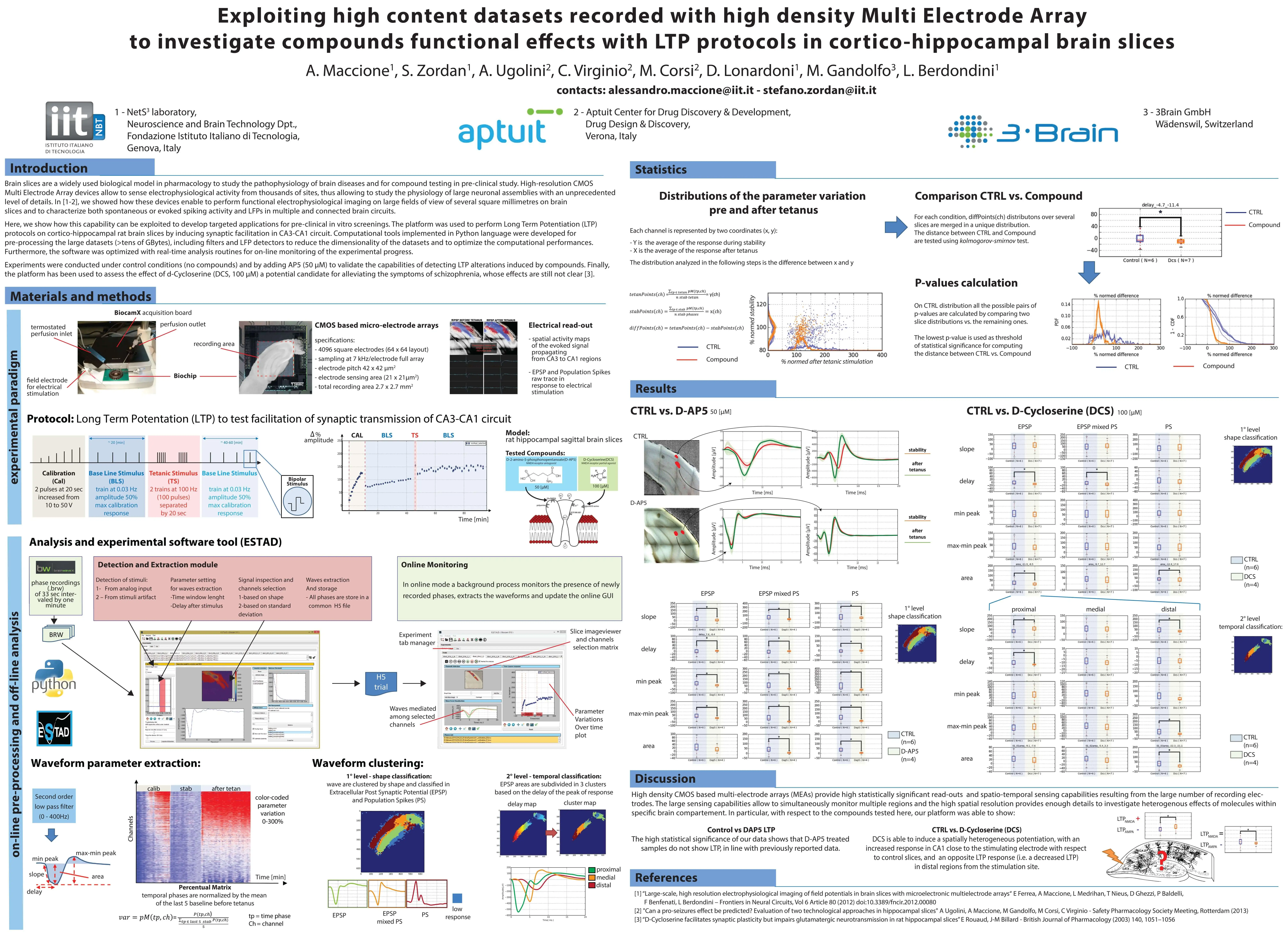
Exploiting high content datasets recorded with high density Multi Electrode Array to investigate compounds functional effects with LTP protocols in cortico-hippocampal brain slices
SFN conference (2016). San Diego, CA, USA.
2016
Keywords:
Acute Retina
(paper)
Dampening Spontaneous Activity Improves the Light Sensitivity and Spatial Acuity of Optogenetic Retinal Prosthetic Responses
Sci. Rep. (2016). DOI: 10.1038/srep33565
2016
Keywords:
Retinitis pigmentosa is a progressive retinal dystrophy that causes irreversible visual impairment and blindness. Retinal prostheses currently represent the only clinically available vision-restoring treatment, but the quality of vision returned remains poor. Recently, it has been suggested that the pathological spontaneous hyperactivity present in dystrophic retinas may contribute to the poor quality of vision returned by retinal prosthetics by reducing the signal-to-noise ratio of prosthetic responses. Here, we investigated to what extent blocking this hyperactivity can improve optogenetic retinal prosthetic responses. We recorded activity from channelrhodopsin-expressing retinal ganglion cells in retinal wholemounts in a mouse model of retinitis pigmentosa. Sophisticated stimuli, inspired by those used in clinical visual assessment, were used to assess light sensitivity, contrast sensitivity and spatial acuity of optogenetic responses; in all cases these were improved after blocking spontaneous hyperactivity using meclofenamic acid, a gap junction blocker. Our results suggest that this approach significantly improves the quality of vision returned by retinal prosthetics, paving the way to novel clinical applications. Moreover, the improvements in sensitivity achieved by blocking spontaneous hyperactivity may extend the dynamic range of optogenetic retinal prostheses, allowing them to be used at lower light intensities such as those encountered in everyday life.

Technology
(paper)
Specific Neuron Placement on Gold and Silicon Nitride-Patterned Substrates through a Two-Step Functionalization Method
Langmuir (2016). DOI: 10.1021/acs.langmuir.6b01352.
2016
Keywords:
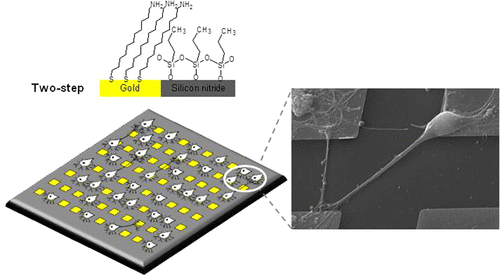
The control of neuron–substrate adhesion has been always a challenge for fabricating neuron-based cell chips and in particular for multielectrode array (MEA) devices, which warrants the investigation of the electrophysiological activity of neuronal networks. The recent introduction of high-density chips based on the complementary metal oxide semiconductor (CMOS) technology, integrating thousands of electrodes, improved the possibility to sense large networks and raised the challenge to develop newly adapted functionalization techniques to further increase neuron electrode localization to avoid the positioning of cells out of the recording area. Here, we present a simple and straightforward chemical functionalization method that leads to the precise and exclusive positioning of the neural cell bodies onto modified electrodes and inhibits, at the same time, cellular adhesion in the surrounding insulator areas. Different from other approaches, this technique does not require any adhesion molecule as well as complex patterning technique such as μ-contact printing. The functionalization was first optimized on gold (Au) and silicon nitride (Si3N4)-patterned surfaces. The procedure consisted of the introduction of a passivating layer of hydrophobic silane molecules (propyltriethoxysilane [PTES]) followed by a treatment of the Au surface using 11-amino-1-undecanethiol hydrochloride (AT). On model substrates, well-ordered neural networks and an optimal coupling between a single neuron and single micrometric functionalized Au surface were achieved. In addition, we presented the preliminary results of this functionalization method directly applied on a CMOS-MEA: the electrical spontaneous spiking and bursting activities of the network recorded for up to 4 weeks demonstrate an excellent and stable neural adhesion and functional behavior comparable with what expected using a standard adhesion factor, such as polylysine or laminin, thus demonstrating that this procedure can be considered a good starting point to develop alternatives to the traditional chip coatings to provide selective and specific neuron–substrate adhesion.

Acute Retina
(paper)
Rank order coding: a retinal information decoding strategy revealed by large-scale multielectrode array retinal recordings.
ENeuro (2016). DOI: 10.1523/ENEURO.0134-15.2016.
2016
Keywords:
How a population of retinal ganglion cells (RGCs) encodes the visual scene remains an open question. Going beyond individual RGC coding strategies, results in salamander suggest that the relative latencies of a RGC pair encode spatial information. Thus, a population code based on this concerted spiking could be a powerful mechanism to transmit visual information rapidly and efficiently. Here, we tested this hypothesis in mouse by recording simultaneous light-evoked responses from hundreds of RGCs, at pan-retinal level, using a new generation of large-scale, high-density multielectrode array consisting of 4096 electrodes. Interestingly, we did not find any RGCs exhibiting a clear latency tuning to the stimuli, suggesting that in mouse, individual RGC pairs may not provide sufficient information. We show that a significant amount of information is encoded synergistically in the concerted spiking of large RGC populations. Thus, the RGC population response described with relative activities, or ranks, provides more relevant information than classical independent spike count- or latency- based codes. In particular, we report for the first time that when considering the relative activities across the whole population, the wave of first stimulus-evoked spikes is an accurate indicator of stimulus content. We show that this coding strategy coexists with classical neural codes, and that it is more efficient and faster. Overall, these novel observations suggest that already at the level of the retina, concerted spiking provides a reliable and fast strategy to rapidly transmit new visual scenes.
Keywords
Ganglion cells, multielectrode array, population coding, rank order coding, retina

Neuronal Cultures
(paper)
State-Dependent Propagation of Neuronal Sub-Population in Spontaneous Synchronized Bursts
Front. Syst. Neurosci. (2016). DOI: 10.3389/fnsys.2016.00028.
2016
Keywords:
Repeating stable spatiotemporal patterns emerge in synchronized spontaneous activity in neuronal networks. The repertoire of such patterns can serve as memory, or a reservoir of information, in a neuronal network; moreover, the variety of patterns may represent the network memory capacity. However, a neuronal substrate for producing a repertoire of patterns in synchronization remains elusive. We herein hypothesize that state-dependent propagation of a neuronal sub-population is the key mechanism. By combining high-resolution measurement with a 4096-channel complementary metal-oxide semiconductor (CMOS) microelectrode array (MEA) and dimensionality reduction with non-negative matrix factorization (NMF), we investigated synchronized bursts of dissociated rat cortical neurons at approximately 3 weeks in vitro. We found that bursts had a repertoire of repeating spatiotemporal patterns, and different patterns shared a partially similar sequence of sub-population, supporting the idea of sequential structure of neuronal sub-populations during synchronized activity. We additionally found that similar spatiotemporal patterns tended to appear successively and periodically, suggesting a state-dependent fluctuation of propagation, which has been overlooked in existing literature. Thus, such a state-dependent property within the sequential sub-population structure is a plausible neural substrate for performing a repertoire of stable patterns during synchronized activity.

Signal Processing
(paper)
ToolConnect: a functional connectivity toolbox for in vitro networks
Front. Neuroinform. (2016). DOI: 10.3389/fninf.2016.00013
2016
Keywords:
Nowadays, the use of in vitro reduced models of neuronal networks to investigate the interplay between structural-functional connectivity and the emerging collective dynamics is a widely accepted approach. In this respect, a relevant advance for this kind of studies has been given by the recent introduction of high-density large-scale Micro-Electrode Arrays (MEAs) which have favored the mapping of functional connections and the recordings of the neuronal electrical activity. Although, several toolboxes have been implemented to characterize network dynamics and derive functional links, no specifically dedicated software for the management of huge amount of data and direct estimation of functional connectivity maps has been developed. toolconnect offers the implementation of up to date algorithms and a user-friendly Graphical User Interface (GUI) to analyze recorded data from large scale networks. It has been specifically conceived as a computationally efficient open-source software tailored to infer functional connectivity by analyzing the spike trains acquired from in vitro networks coupled to MEAs. In the current version, toolconnect implements correlation- (cross-correlation, partial-correlation) and information theory (joint entropy, transfer entropy) based core algorithms, as well as useful and practical add-ons to visualize functional connectivity graphs and extract some topological features. In this work, we present the software, its main features and capabilities together with some demonstrative applications on hippocampal recordings.

Neuronal Cultures
(paper)
Electrical responses and spontaneous activity of human iPS-derived neuronal networks characterized for three-month culture with 4096-electrode arrays
Front. Neurosci. (2016). DOI: 10.3389/fnins.2016.00121.
2016
Keywords:
The recent availability of human induced pluripotent stem cells (hiPSCs) holds great promise as a novel source of human-derived neurons for cell and tissue therapies as well as for in vitro drug screenings that might replace the use of animal models. However, there is still a considerable lack of knowledge on the functional properties of hiPSC-derived neuronal networks, thus limiting their application. Here, upon optimization of cell culture protocols, we demonstrate that both spontaneous and evoked electrical spiking activities of these networks can be characterized on-chip by taking advantage of the resolution provided by CMOS multielectrode arrays (CMOS-MEAs). These devices feature a large and closely-spaced array of 4096 simultaneously recording electrodes and multi-site on-chip electrical stimulation. Our results show that networks of human-derived neurons can respond to electrical stimulation with a physiological repertoire of spike waveforms after 3 months of cell culture, a period of time during which the network undergoes the expression of developing patterns of spontaneous spiking activity. To achieve this, we have investigated the impact on the network formation and on the emerging network-wide functional properties induced by different biochemical substrates, i.e., poly-dl-ornithine (PDLO), poly-l-ornithine (PLO), and polyethylenimine (PEI), that were used as adhesion promoters for the cell culture. Interestingly, we found that neuronal networks grown on PDLO coated substrates show significantly higher spontaneous firing activity, reliable responses to low-frequency electrical stimuli, and an appropriate level of PSD-95 that may denote a physiological neuronal maturation profile and synapse stabilization. However, our results also suggest that even 3-month culture might not be sufficient for human-derived neuronal network maturation. Taken together, our results highlight the tight relationship existing between substrate coatings and emerging network properties, i.e., spontaneous activity, responsiveness, synapse formation and maturation. Additionally, our results provide a baseline on the functional properties expressed over 3 months of network development for a commercially available line of hiPSC-derived neurons. This is a first step toward the development of functional pre-clinical assays to test pharmaceutical compounds on human-derived neuronal networks with CMOS-MEAs.
Signal Processing
(paper)
Spike detection for large neural populations using high density multielectrode arrays
Frontiers in Neuroinformatics (2015). ISSN:1662-5196 DOI:10.3389/fninf.2015.00028
2015
Keywords:
An emerging generation of high-density microelectrode arrays (MEAs) is now capable of recording spiking activity simultaneously from thousands of neurons with closely spaced electrodes. Reliable spike detection and analysis in such recordings is challenging due to the large amount of raw data and the dense sampling of spikes with closely spaced electrodes. Here, we present a highly efficient, online capable spike detection algorithm, and an offline method with improved detection rates, which enables estimation of spatial event locations at a resolution higher than that provided by the array by combining information from multiple electrodes. Data acquired with a 4096 channel MEA from neuronal cultures and the neonatal retina, as well as synthetic data, was used to test and validate these methods. We demonstrate that these algorithms outperform conventional methods due to a better noise estimate and an improved signal-to-noise ratio (SNR) through combining information from multiple electrodes. Finally, we present a new approach for analyzing population activity based on the characterization of the spatio-temporal event profile, which does not require the isolation of single units. Overall, we show how the improved spatial resolution provided by high density, large scale MEAs can be reliably exploited to characterize activity from large neural populations and brain circuits.

.svg)